gaskets
- November 24, 2022
KLINGERSIL® C-7400 Isolation Gaskets
Application Overview:
Some applications in plants call out for isolation kits to maintain the integrity and reliability of a pipeline and piping system. Isolation kits are designed to work in conjunction with flanges,
- August 09, 2022
When PTFE (polytetrafluorethylene) was developed in 1938, its importance to industrial sealing was quickly recognized because of its tremendous chemical resistance.
While use of PTFE as a gasket material increased in industrial applications, complaints about certain properties surfaced: skive marks made initial sealing difficult, cold flow caused leakage and premature failure, and temperature/pressure cycling was a problem.
Lorem ipsum dolor sit amet, consectetur adipiscing elit. Ut elit tellus, luctus nec ullamcorper mattis, pulvinar dapibus leo. - February 10, 2021
This blog will discuss the differences between ASME flanges and AWWA flanges and the gaskets associated with each.
ASME flanges are the most widely used and specified flanges throughout industry in North America. Flange sizes ½” through 24” fall under ASME B16.5 and flange sizes 26” through 60” fall under ASME B16.47. Within ASME B16.47 there are series A and series B flanges, with the noticeable differences in most cases being the bolt size and/or bolt quantity.
- August 05, 2020
So you spend hundreds or even thousands of dollars every year on sealing solutions, like gaskets. But did you know that the way you store your gaskets could affect the effectiveness or life span of your gaskets? In this blog, we offer some tips for gasket storage and shelf life which, if followed, can help ensure that your gaskets are always ready for service.
Gasket Storage and Shelf Life: General Storage Principles
Rubber gaskets should always be stored in a cool location which is free from excessive humidity, direct sunlight, and the presence of chemical vapours or fumes. The storage location should ideally be indoors and free from exposure to the elements or inclement weather. If the storage guidelines given below are followed, rubber gaskets or gasketed components have the following expected shelf life:
Tips for Gasket Storage and Shelf Life
Tip #1: Limit exposure to light
Sunlight and strong artificial light can degrade some gasket materials. For this reason, rubber gaskets should be stored in cartons or opaque bags which prevent direct exposure to light.
Tip #2: Maintain relative humidity levels
Very moist or excessively dry conditions in a storage location should be avoided. Relative humidity levels below 75% are recommended for most rubber gaskets. Similarly, very low humidity levels which can cause some materials to dry out and become brittle should also be avoided.
- July 10, 2020
Under pressure? Absolutely. The increasingly high temperatures and harsh conditions to which gaskets are exposed makes selecting the right gasket all the more important.
In industries such as chemical processing, hydrocarbon refining, and power generation, leakage from extreme temperature process streams can result in loss of efficiency and production as well as adverse environmental impacts and compromised employee safety. One of the most commonly used sealing products in systems subject to high pressures and temperatures is a spiral-wound gasket. These gaskets typically consist of filler and winding materials selected on the basis of application requirements and end-user preference. Proper selection of these materials is critical to achieving the desired performance in all applications.
Material Selection
Sealing at temperatures above 850 ºF (454 ºC) is particularly challenging because of the limited number of filler materials that can resist thermal degradation at extreme temperatures – these temperatures affect both the sealing material and metal components. For instance, the yield strength of fasteners decreases as the temperature is increased. In addition certain chemicals can become more volatile and aggressive in high-temperature reaction processes.
The two most common filler materials in spiral-wound gaskets are graphite (can withstand temperatures up to 850 ºF) and polytetrafluoroethylene (PTFE; tolerance up to 500 ºF). Other filler materials are used mainly for their thermal insulating properties, not for sealability; these include mica, exfoliated mica, and ceramics. While graphite and PTFE perform satisfactorily in terms of temperature and chemical resistance, they have limitations. Graphite is not compatible with heavily oxidizing media at any temperature, nor can it withstand continuous operating temperatures above 850 ºF. Beyond 850 ºF, volume loss through oxidation becomes excessive and sealing effectiveness is compromised.
Many high-temperature systems, such as exhaust manifolds and flanged piping connections in exhaust systems, are oxidizing. Other services are oxidizing because of the operating temperature and media involved.
- December 05, 2019
Article re-posted with permission from Parker Hannifin Sealing & Shielding Team.
Original content can be found on Parker’s Website and was written by Ben Nudelman, Market Development Engineer, Chomerics Division.
Form-in-place EMI gaskets, also known as FIP EMI gaskets, is a robotically dispensed electromagnetic interference (EMI) shielding solution that is ideal for modern densely populated electronics packaging.
- November 05, 2019
Enhancing the surface profile can improve sealing capabilities, extending the functionality of aging piping systems in chemical plants.
There are many aged and aging process plants in operation today. In fact, many of the processing plants for power, chemicals, oil, etc., have been in service for more than 50 years. And while the piping itself may remain intact, their bolted flange gasket joints and connections are becoming misaligned, corroded and damaged due to repeated handling, chemical exposure and thermal cycling. This can lead to costly ruptures that may result in millions of dollars in damages, downtime, noncompliance penalties, irreparable environmental impact and litigation.
There is a solution that can extend the life of aging piping systems, preserving their functionality: raising the surface profile on polytetrafluoroethylene (PTFE) gaskets. This design modification can prevent leaks, spills and other releases in chemical processing plants by reducing and managing the contacted area of the gasket, thus achieving and maintaining a strong seal.
A Brief History of Gasket Technology
Traditionally, gasket thickness and sealability always involved a performance tradeoff. One could use 1/16-inch-thick (1.6 millimeter) gaskets when flanges were in good condition, achieving a tight seal with reduced creep.
However, when the flanges had bad or misaligned surfaces, the seal integrity was degraded.
In those instances when the flanges are in poor condition (or if the shape of the flange condition is unknown), one would choose a 1/8-inch-thick (3.2 mm) gasket. The reason? A user does not want to risk installing a thinner gasket and discover that it does not seal properly, which then requires a timely and costly uninstall and reinstall. However, the thicker gaskets do not seal as well as their 1/16-inch counterparts when placed under comparable load. Additionally, with the thicker gaskets, creep is higher, requiring re-torque.
To address the limitations of both gasket options, the ideal gasket should combine the creep resistance of a 1/16-inch gasket with the compressibility and conformability of a 1/8-inch gasket—easier said than done.
Historically, gaskets have not always been forgiving, easy to use or simple to remove. Yet technology has evolved, allowing sealing products to be engineered and designed to optimize the work that is put into them, delivering a tighter, more durable seal.
The approach is one that does not focus on the gasket thickness but rather its surface profile. The results produce gaskets that reduce leaks, spills and other releases from piping systems, including those of aging chemical plants.
Gylon EPIX Sheet Material Raising the Gasket Profile
The concept of using surface profiling to reduce area and increase stress is found in many products, such as running shoes and car tires. Reducing the contact area while maintaining a given amount of compressive force results in increased stress. In the case of shoes or tires, this stress provides traction. In the case of gaskets, traction or friction between a gasket and a flange face is critical to holding internal pressure. If the downward force created by the fasteners in a flange is evenly spread over a larger area, the created stress contributes to making a seal more effective. This approach enables the aging piping system to maximize its sealing potential.
Impact on Raising Gasket Profile
Surface profiling positively impacts gasket technology in five key areas: compressibility, pressure resistance, scalability, load retention and dimensional flexibility.
Compressibility
Compressibility is a critical functionality of gaskets, as it represents the ability of the gasket to conform to the surfaces that it seals. Adding raised features to the surface of a gasket directly impacts compressibility by reducing the contact area and increasing the resulting stress.
When flange surfaces are worn, pitted or scratched—such as those in aging piping systems in chemical plants—it can be cost prohibitive and nearly impossible to repair/replace the flange to a “good as new” condition. The more compressible the gasket, the better chance of producing an effective seal with the flanges.
- July 02, 2019
Wine Manufacturing with GYLON®
Gylon 3504
The GYLON® Style 3504 gasket is made of PTFE with aluminosilicate microspheres. It is designed for use in many acids, some caustics, hydrocarbons, refrigerants, and more.
Gylon 3545
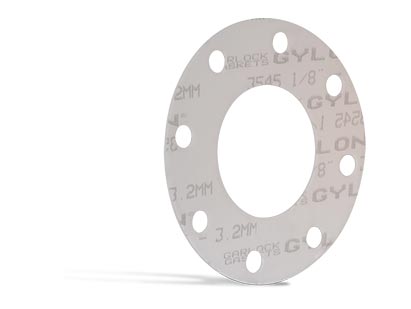
The Garlock 3545 style is a highly compressible microcellular PTFE with a rigid PTFE core for improved handlability. Garlock 3545, made with Gylon material, is designed to compress and conform to irregular or damaged surfaces, making it suitable for flanges that generate lower compressive stresses, such and glass-lined flanges and equipment.
INDUSTRY
Food & Beverage – Wine Production
CUSTOMER
An award-winning, family owned & operated winery in the heart of a major US wine-growing region.
BACKGROUND
The customer crushes, presses, ferments, bottles, and labels all of their wines at their winery, but having traditionally utilized EPDM gaskets, they faced ongoing issues with seal reliability. This was occurring during various stages of the winemaking process, but especially so during the sterilization procedures between each batch, with subsequent leaks creating issues in production reliability, housekeeping, and potential contamination.
CHALLENGES FACED
Business was growing rapidly so new equipment had been installed, but at the same time the number of maintenance windows was reducing. Therefore the customer was looking for a more reliable and sanitary product to improve efficiency and help to protect the sensitive product. As well as the need to remain absolutely compliant with industry standards, the customer also placed utmost importance on prevention of any adulteration of their award-winning wine. As well as working around limited windows of opportunity for production trials the critical and expert opinion of wine tasters was therefore essential to ensure full approval of any component change in the process.
- January 11, 2018
Sealex® joint sealant, specially processed, 100% pure PTFE on a roll, provides soft, highly compressible gasketing for longer life and trouble-free sealing. Its form-in-place versatility also cuts maintenance and storage costs. The high compressibility of Sealex® enables it to effectively fill flange imperfections for a tight, leak-free seal. Under pressure, it provides a very wide, thin ribbon-like joint sealant. Unlike conventional PTFE which is prone to cold flow, Sealex® has good creep resistance and bolt torque retention properties.
Sealex® joint sealant does not support bacterial growth or cause product contamination and is FDA compliant. It has virtually no shelf-life concerns since PTFE is unaffected by normal environmental conditions.
It has excellent resistance properties to chemical attack. It is ideal for most chemical services at temperatures to 500°F (260°C) and pressure to 2,000 psi (138 bar). It is also suitable for cryogenic use to -321°F (-196°C).
- May 09, 2017
Gallagher Fluid Seals is the trusted supplier of MRO sealing materials - including gasketing, packing, expansion joints, etc. - to all kinds of plants and manufacturers throughout the northeast and mid-Atlantic. At Gallagher, we take the time to specify the right gasket for every application, and we do our best to keep our customers well-informed about industry best practices and sealing safety.
The following is an article recently published in Pumps & Systems Magazine, which discusses why you should NEVER reuse a gasket.
Sealing Sense
by Jim Drago & Ron Frisard
Safety is a concern at any industrial site. An Occupational Safety and Health Administration compliance specialist has stated that safety should be more than a priority: “Priorities in an organization can and usually do change. Safety and health need to be a core value of the organization.”1